 NASA Tournament LabHosted challenge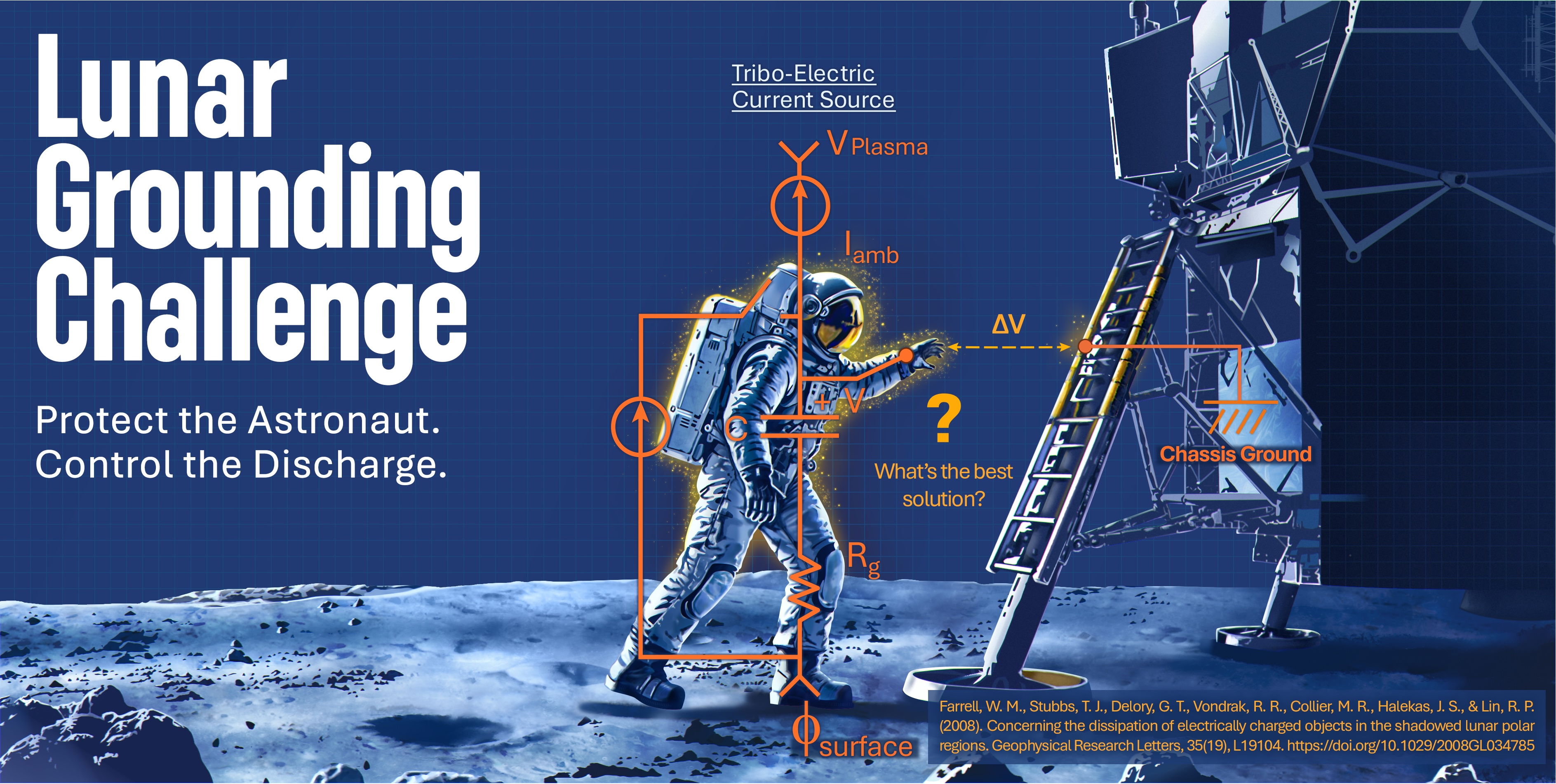
Synopsis
NASA is seeking innovative designs and operational solutions to provide a lunar bringing to equilibrium capability to safely discharge a suited astronaut from high triboelectric charge buildup during lunar Surface Extravehicular Activities (EVAs) in the South Pole.
Background of the Problem
As an astronaut traverses the lunar South Pole, tribocharging from walking on the lunar surface and plasma charging from the ambient plasma generate electric charge on the spacesuit. This problem is severely compounded when entering lunar shadows and Permanently Shadowed Regions (PSRs). In these dark zones, the spacesuit can buildup a substantial negative potential due to a lack of ambient ion flux and the absence of photoelectron emission to balance ambient electron collection.
The risk occurs when an astronaut returns to the spacecraft. Because the lunar surface lacks a natural environmental mechanism to bleed the charge accumulated on spacesuit away, the astronaut may become a walking, high voltage capacitor.
In the sunlit region, the stationary lander will hold slightly positive electrical potential. When a highly negatively-charged astronaut approaches the vehicle, the extreme voltage differential can trigger electrostatic discharge (an instantaneous electrical arc, or a spark) during physical contact. A rapid discharge from the astronaut to the lander risks degrading vital suit layers, damaging sensitive suit electronics, threatening the oxygen-rich environment inside the suit, and delivering dangerous electrical shocks to the crew.
Description
NASA is seeking innovative designs and operational solutions to provide a lunar bringing to equilibrium capability to safely discharge a suited astronaut from high triboelectric charge buildup during lunar surface EVAs in the South Pole. This challenge seeks innovative concepts for an Electrostatic Discharge (ESD) mitigation solution to neutralize the astronaut in a safe and timely manner under this extreme charge differential before astronauts directly interact with the lander.
The proposed Lunar bringing to equilibrium design and operational solution must be capable of providing a safe non-arcing discharge from a negatively charged astronaut at -100kV or greater to an approximately +100V Lander. The solution specifically with the interface to the suit must not exceed a discharge current 1.0 mA, with a design target of less than or equal to 0.2 mA to remain below human perception levels. If an arc is present, it must not contact the suit or astronaut.
The proposed solution must minimize mass, volume, and power impacts and be operable in the harsh lunar environment’s surface conditions. The solution must be less than 20kg and dimensional and power constraints will be defined during challenge design. The solution must support up to four EVAs over 10 days being exposed to the lunar environment. In addition, the suspended lunar dust and heavy dust buildup on a suit in these environments significantly increases arcing lengths, allowing sparks to jump across larger gaps than they would in a clean vacuum. Therefore, the solution must aim to avoid a sudden arc that may come into contact with the outer pressure garment (suit) or the lander.
Design and environmental considerations include:
- Lunar Surface Gravity: 0.165g
- Lunar Temperatures: -361F to -31F (Artemis IV average temperature range)
- Lunar Dust (particulate size): Range from ~0.02 μm -10 μm
- Worst case discharge duration: 30 seconds
Design Assumptions:
- The EVA suit will have attachment points that can be used for bonding to the lunar bringing to equilibrium design solution.
- The Lander will have attachment points that can be used for bonding to the lunar bringing to equilibrium design solution.
- The Lander will provide interface points that can be used to draw vehicle power (40 Watts Max) if required to power the lunar bringing to equilibrium design solution.
- The Lander will provide powered heaters that can be used for supporting design solution performance if required to thermally regulate the lunar ground design solution.
- The suited astronaut will have a 200 pF capacitance model.
- The lunar bringing to equilibrium design solution will not present a hazard to the astronaut or cause damage or alteration to the EVA suit material.
This Challenge has two phases: 1) Concept Design Submission and 2) Concept Refinement.
Phase 1: Concept Design Submission
Phase 1 aims to identify promising design and operational concepts that provide a lunar bringing to equilibrium capability to safely discharge a suited astronaut from high triboelectric charge buildup during lunar Surface EVAs at the South Pole.
No fabrication or physical prototype testing is required.
After Phase 1 judging, up to five finalists will be selected to advance to Phase 2.
Phase 2: Concept Refinement
Phase 2 gives finalists the chance to strengthen their concepts based on reviewer feedback before final judging.
Only Phase 1 finalists are eligible to submit to Phase 2.
Each finalist will receive consolidated written feedback from the Reviewer Panel. The feedback will identify gaps or weaknesses in the concept but will not propose design solutions.
Refined submissions will be scored against the same Judging Criteria as Phase 1 using the same process.
Statutory Authority to Conduct the Challenge
The Business Development and Technology Integration Office (BD&TI) within National Aeronautics and Space Administration (NASA) is conducting this Challenge under the Federal Acquisition Regulation (FAR) 52.225-5 Trade Agreements.
A challenge, also known as a prize competition, is an open solicitation in which Participants propose solutions to a defined problem and the highest-ranked submissions may receive a prize. Unlike grants and contracts, cash prizes awarded under this Challenge may be used at the winner's discretion, and no reporting on the use of prize funds is required. Receipt of a prize is contingent upon completion of the winner verification, payment, and intellectual property documentation described in these rules.
Ready to take part? Registration is open.
Powered by CrowdPlat